Public vs Private Schools in Franklin, TN: An Honest Comparison
Choosing the right school is one of the biggest decisions when relocating to Franklin, Tennessee. With strong public options and a variety of private schools nearby, many families wonder which path is right for their child. This honest comparison breaks down the key differences, typical experiences, and what to consider before making your choice.
Overview of Public Schools in Franklin, TN
Franklin’s public education system is highly regarded, and many families relocate here specifically for the schools. There are two main public systems that serve the city:
Franklin Special School District (K-8)
The Franklin Special District serves kindergarten through eighth grade. It operates its own budget, focuses on academic excellence, and consistently ranks well in testing and performance. (fssd.org)
Williamson County Schools (High School)
Once students complete eighth grade, they typically transition into Williamson County Schools, which serves high schoolers and is known as one of the top public districts in the state of Tennessee. (wcs.edu)
Public School Options and Quality
Public schools in Franklin and Williamson County receive strong ratings and tend to perform well above state averages.
-
Franklin public schools rank among the top in Tennessee based on test scores and college readiness data. (Public School Review)
-
Schools like Centennial High School and Franklin High School are often rated highly for academics and extracurriculars.
-
Public schools are also typically larger, offering a wide range of programs, sports, music, and advanced coursework.
Pros of Public Schools
-
No tuition cost
-
Large, diverse student body
-
Broad extracurricular options
-
Strong community identity
Considerations
-
Larger class sizes
-
Less customization for individual learning pace
Private School Options in Franklin
There are many private school choices in Franklin and the surrounding area, and they vary widely in size, philosophy, and curriculum.
Some well-known private schools include:
-
Battle Ground Academy – A college preparatory school serving PreK to 12th grade with a strong reputation for academics and community involvement. (Wikipedia)
-
Franklin Classical School – Known for a rigorous classical education from kindergarten through high school. (Niche)
-
Trinitas Classical Academy – Smaller school with individualized attention. (Niche)
-
Grace Christian Academy – Offers Christian-based education from pre-K through high school. (Niche)
-
Montessori School of Franklin – Focuses on self-directed learning in early years. (National Center for Education Statistics)
There are many other private options as well, each with its own strengths, size, and tuition structures. (Niche)
Pros of Private Schools
-
Smaller class sizes
-
Often more individualized attention
-
Specific educational philosophies or religious frameworks
-
Opportunities for unique programs not found in public schools
Considerations
-
Tuition fees, which vary widely
-
Limited extracurricular offerings at smaller schools
-
Travel and logistics for families living farther from campus
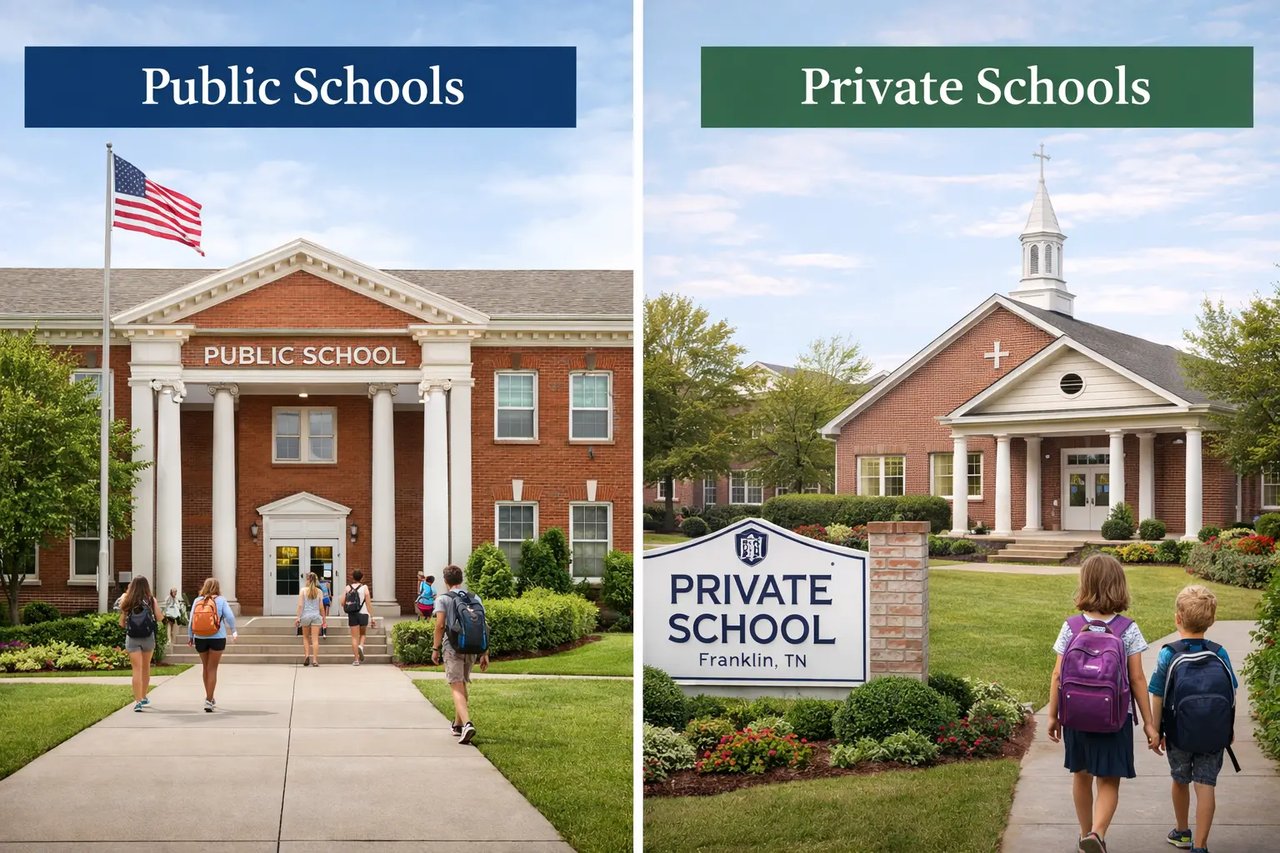
Comparing Public vs Private Side by Side
| Feature | Public Schools | Private Schools |
|---|---|---|
| Cost | Free | Tuition required |
| Student-Teacher Ratio | Often larger | Typically smaller |
| Class Size | Larger | Smaller |
| Program Range | Extensive | Varies by school focus |
| Religious/Philosophical Choices | Rare | Many options |
| Admissions | Based on address | Application required |
Academic Performance & Outcomes
Public schools in Franklin and Williamson County generally rank very high in standardized testing, with reading and math scores often above state averages. (Public School Review)
Many private schools also report strong academic results, often reflected in smaller class sizes and individualized programs designed to prepare students for college or specialized interests. (Niche)
Social and Community Considerations
Public schools often reflect the wider diversity of the community and provide a broad social experience for children of varying interests.
Private schools may offer a more tight-knit atmosphere, where smaller class sizes create a sense of close community and personalized relationships.
Both have benefits depending on the type of environment you want for your child.
Cost Considerations
Public school is funded by taxpayers and does not carry tuition costs, though additional fees may apply for field trips, athletics, and supplies.
Private schools charge tuition, which varies by school, grade level, and program offerings. Some private schools also offer financial aid or scholarships, but tuition remains a key consideration for many relocating families.
How to Choose What’s Right For Your Family
Here are useful tips when comparing public and private:
1. Visit schools in person or virtually.
Tours and conversations help you feel the culture and fit.
2. Understand your child’s needs.
Some thrive in smaller class environments, others enjoy the variety of public school programs.
3. Consider logistics.
Commute times, before and after school care, and family schedules all play a role.
4. Ask about extracurriculars.
Sports, arts, and clubs vary widely between systems.
Frequently Asked Questions
Is one system better than the other?
There is no universal answer. It depends on your child’s learning style, family priorities, and budget.
Are Franklin public schools competitive?
Yes. Many are highly rated and among the best in Tennessee. (Public School Review)
Do private schools require entrance exams?
Some do, but requirements vary by school.
Can children switch between public and private easily?
Yes, but timing and enrollment periods matter.
Do private schools offer financial aid?
Many offer tuition assistance. Check directly with each school.
Conclusion
When deciding between public and private schools in Franklin, TN, there is no one right choice for every family. Public schools offer excellent academics with wide programs and no tuition. Private schools provide smaller environments, individualized attention, and specialized options.
Your child’s personality, family values, and logistics should guide your choice. Talking with both public school administrators and private school leaders can give you the deepest clarity before making the move.
If you want help comparing specific schools based on your child’s grade level and interests, I can walk you through a tailored breakdown with performance, culture, and community fit.