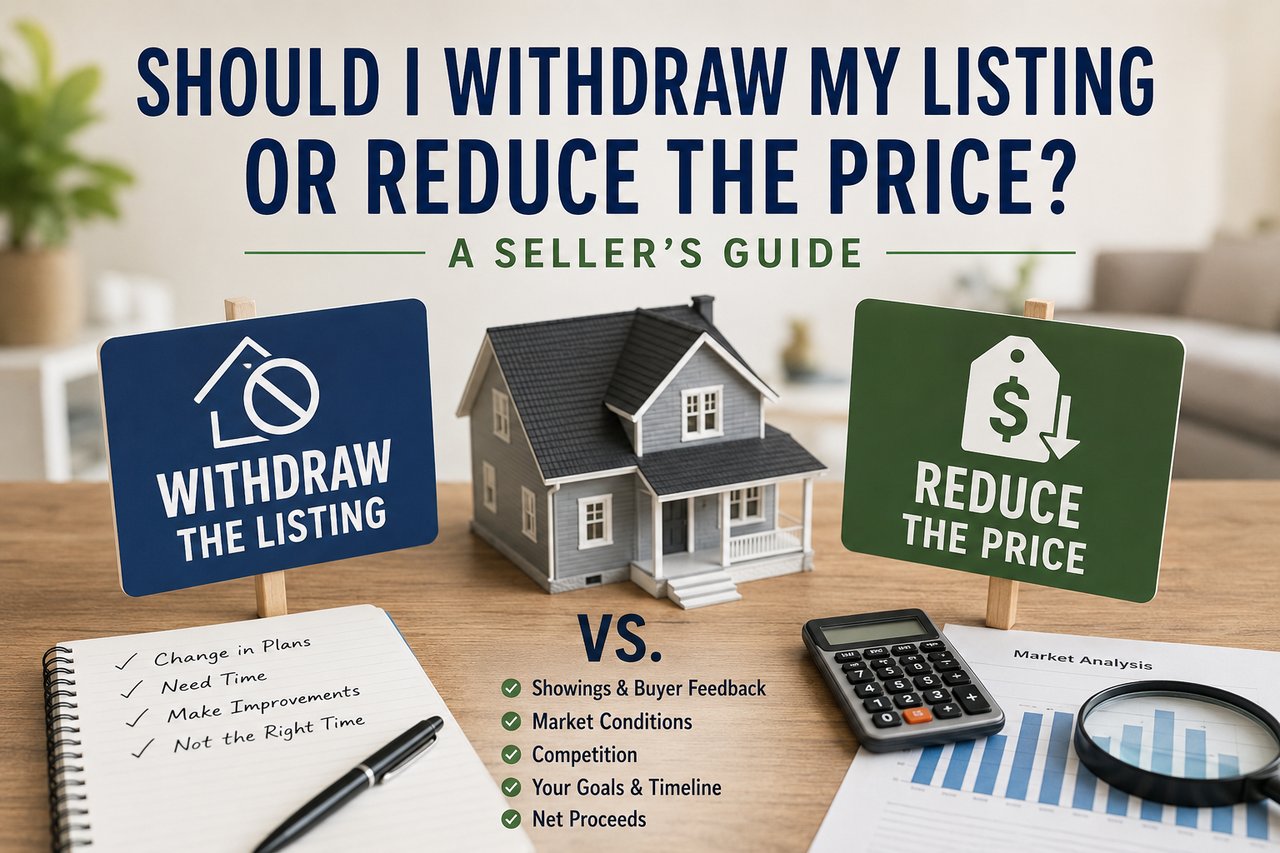
Should I Withdraw My Listing or Reduce the Price? A Seller’s Guide
Selling your home can be an emotional and financial decision. When you put your property on the market, you naturally hope interested buyers will schedule showings, make offers, and eventually compete for the opportunity to purchase it.
But what happens when that doesn’t occur?
Maybe your home has been listed for weeks without an offer. Perhaps showings started strong and suddenly slowed down. Or buyers are touring the property but consistently choosing other homes.
At that point, many homeowners begin asking the same question:
Should I withdraw my listing or reduce the price?
There is no single answer that works for every seller. If you still want or need to sell, a strategic price adjustment may be the better option. If your circumstances have changed, the property needs significant improvements, or you are unwilling to sell at a price supported by the current market, withdrawing the listing may make more sense.
The key is determining why your home isn’t selling before deciding what to do next.
Why Isn’t My House Selling?
A home can remain on the market for many reasons, and price is only one of them.
Before reducing your asking price or taking your property off the market, look at what buyers have been telling you through their actions.
Are they clicking on the listing?
Are they scheduling showings?
Are they returning for second visits?
Are they making offers?
The answers can reveal where the problem may be.
The Listing Price May Be Too High
One of the most common reasons a home struggles to attract buyers is that the asking price does not align with buyers’ perception of value.
Sellers often think about price in terms of what they paid for the property, how much they invested in improvements, how much they need from the sale, or what a neighbor received for a similar home.
Buyers usually look at the situation differently.
They compare your home with other properties currently available within their budget.
If another property offers a renovated kitchen, larger yard, better location, newer systems, or additional living space for a similar price, buyers may perceive that home as the better value.
That does not necessarily mean something is wrong with your property.
It may simply mean the price-to-value relationship needs to change.
Your Home May Not Be Getting Enough Showings
Very few showings can be an important signal.
If buyers who should logically be interested in the property are not even scheduling appointments, consider whether the issue is:
- Price
- Photography
- Property presentation
- Listing description
- Marketing exposure
- Showing restrictions
- Competition
- Location
- Condition
Price often plays an especially important role because buyers frequently search within specific price ranges.
A home priced just outside a buyer’s maximum search amount may never appear in that buyer’s results.
Buyers Are Touring the Home but Not Making Offers
A steady flow of showings with no offers tells a different story.
Buyers are interested enough in the photos, location, features, and price to visit the home. Something changes once they see it in person.
Possible concerns may include:
- Condition
- Needed repairs
- Layout
- Room size
- Noise
- Odors
- Outdated finishes
- Lack of storage
- Landscaping
- Nearby properties
- Overall value compared with competing homes
This is where detailed buyer feedback becomes extremely valuable.
One person’s opinion may not mean much.
A repeated pattern deserves attention.
Market Conditions May Have Changed
Real estate markets are constantly changing.
The conditions that existed when you originally determined your asking price may be different several weeks later.
New homes may have entered the market. Competing sellers may have reduced their prices. Recent comparable properties may have sold for less than expected.
Buyer demand can also change due to affordability, financing conditions, inventory, seasonality, or local economic factors.
This is why pricing a home should never be viewed as a one-time decision.
It is an ongoing strategy.
When Should You Consider Reducing the Listing Price?
A price reduction can make sense when you still intend to sell but the market is signaling that your current asking price is not generating enough demand.
Here are several situations where adjusting the price may deserve serious consideration.
You’re Getting Very Few Showings
If similar homes in your area are receiving attention while yours is being overlooked, your price could be preventing buyers from taking the next step.
Online home shoppers make quick comparisons.
They may see dozens of properties within minutes and decide which homes appear to offer the strongest value.
If your home consistently loses that comparison, changing the price may increase interest.
Similar Homes Are Selling While Yours Is Sitting
Your home's competition can provide valuable information.
Suppose several comparable homes enter the market after yours and go under contract while your property remains available.
Ask why.
Were they updated?
Were they priced lower?
Did they offer better amenities?
Was their marketing stronger?
Were they simply positioned more competitively?
A competitive market analysis should consider more than past sales. Your active competition matters because those are the homes buyers are comparing with yours today.
Buyers Keep Saying the Home Is Overpriced
Buyer feedback should be evaluated as a pattern rather than individually.
One buyer saying the home is overpriced may simply mean the property wasn't right for that person.
Ten buyers making similar comments deserve more attention.
When buyers repeatedly like the property but hesitate because of the price, the market may be giving you a clear message.
You Need to Sell Within a Specific Timeframe
Your personal timeline matters.
If you are relocating, buying another home, managing two properties, or trying to complete a move before a specific date, waiting indefinitely for a higher offer may not fit your goals.
The question becomes less about:
“What is the highest price I could theoretically receive?”
And more about:
“What strategy gives me the best combination of price, timing, and certainty?”
Your Listing Has Lost Momentum
New listings naturally attract attention.
Buyers who have been monitoring the neighborhood may notice your property immediately. Agents may send it to clients. Online shoppers may save it or schedule a showing.
As time passes without a sale, buyers sometimes become more cautious.
Instead of asking, “Could this be the right home?”
They may begin asking, “Why hasn't anyone bought it?”
A well-planned price adjustment can sometimes create renewed interest and reposition the property against current competition.
How Much Should You Reduce the Price?
If you decide to reduce the price, the next question is usually:
How much should I lower my home’s asking price?
There is no universal percentage.
A meaningful price adjustment should be based on market evidence rather than an arbitrary number.
Avoid Making a Price Cut Just to Say You Made One
A small reduction may accomplish very little if it does not change how buyers perceive the property.
For example, if market data indicates the home is substantially above comparable properties, a token price adjustment may leave you in essentially the same competitive position.
The objective is not simply to lower the price.
The objective is to reposition the home.
Review Your Current Competition
Before changing the asking price, evaluate:
- Recently sold comparable properties
- Homes currently under contract
- Active listings
- Properties that failed to sell
- Recent price reductions
- Your home's condition
- Your home's upgrades
- Location differences
- Lot size
- Square footage
- Buyer feedback
Your original comparable sales analysis may no longer reflect today's market.
Think About Buyer Search Price Ranges
Many buyers search for homes using minimum and maximum price filters.
That makes certain pricing thresholds important.
Suppose a home is listed slightly above a common buyer search ceiling. Moving below that threshold could potentially introduce the property to an entirely new group of buyers.
A strategic reduction should consider both market value and buyer search behavior.
Combine the Price Change With a Marketing Refresh
Do not treat a price reduction as an isolated event.
Use it as an opportunity to refresh the entire listing strategy.
Consider:
- Updating the property description
- Reordering listing photos
- Replacing weak photography
- Improving staging
- Completing minor repairs
- Increasing showing availability
- Promoting the new price
- Reaching out to agents who previously showed the home
- Hosting a new open house
Give buyers a reason to reconsider the property.
When Does Withdrawing the Listing Make More Sense?
Reducing the price is not always the right answer.
Sometimes temporarily withdrawing the property is the more reasonable decision.
You No Longer Need or Want to Sell
Perhaps your plans have changed.
A job transfer may have fallen through. You may have decided not to purchase another property. Your financial circumstances may be different.
If your reason for moving no longer exists, there may be little benefit in reducing the price simply to force a sale you no longer want.
Your Home Needs Significant Improvements
Sometimes buyer feedback reveals problems that cannot be solved with marketing alone.
Perhaps the home needs substantial repairs, new flooring, exterior work, landscaping, painting, or extensive decluttering.
Temporarily withdrawing the listing may give you the opportunity to address those issues properly instead of repeatedly adjusting the price.
The goal should be to return to the market with a materially stronger offering, not simply the same home after a short pause.
The Timing No Longer Fits Your Goals
Some sellers have flexibility.
If current market conditions do not support the price you need and selling is optional, waiting may be reasonable.
However, there is an important distinction between making an informed decision to wait and simply hoping the market will eventually provide the price you want.
Future market conditions are never guaranteed.
Evaluate your decision based on your financial situation, timeline, and local market—not predictions alone.
Your Personal Circumstances Have Changed
Real estate decisions do not happen in isolation.
A change involving employment, family, finances, relocation plans, or another home purchase may alter whether selling still makes sense.
If the original reason for listing has changed substantially, reevaluating the entire plan may be smarter than automatically lowering the price.
You Need to Completely Rethink the Listing Strategy
Sometimes the problem is larger than price.
The property may need:
- Better preparation
- Different staging
- Professional photography
- More flexible showing arrangements
- A revised marketing strategy
- Different positioning
- A new pricing analysis
In those situations, pausing and rebuilding the strategy may produce a better result than making one small change at a time.
Will Withdrawing and Relisting Make My Home Look New Again?
Some sellers consider withdrawing their home and quickly relisting it because they hope buyers will view it as a brand-new property.
That strategy should be approached carefully.
Listing History May Still Be Visible
Depending on the local real estate system and the tools used by agents and buyers, previous listing activity may still be available.
Removing a property from the market does not necessarily erase its history.
That is why withdrawing and relisting should not be treated merely as a way to disguise the fact that a home previously did not sell.
MLS Rules Can Differ
Rules governing withdrawn, canceled, expired, and relisted properties can vary between multiple listing services and listing agreements.
The treatment of days on market can vary as well.
Before withdrawing a property because you expect a particular outcome, ask your real estate professional how the rules work in your specific market.
A Relisting Should Give Buyers Something New
If you plan to withdraw and later relist, ask:
What will be different the next time buyers see the property?
Maybe the answer is:
- A more competitive price
- Professional staging
- Updated flooring
- Fresh paint
- Improved landscaping
- Better photography
- Completed repairs
- More convenient showings
If absolutely nothing changes, there is a reasonable possibility buyers will respond exactly as they did before.
Price Reduction vs. Withdrawal: Which Is Better?
Here is a simple way to think about the decision.
Consider Reducing the Price If…
A price adjustment may make sense when:
- You still want to sell.
- You need to move within a reasonable timeframe.
- Your home is already in good showing condition.
- Your marketing is strong.
- Similar homes are attracting buyers.
- Comparable market data suggests your price is high.
- Buyers are showing interest but not making offers.
- Holding the property longer creates additional costs.
In this situation, price may be the primary obstacle between you and a buyer.
Consider Withdrawing the Listing If…
Withdrawing may make more sense when:
- You no longer want or need to sell.
- Your personal circumstances have changed.
- Your home needs substantial work.
- You want time to make meaningful improvements.
- You cannot currently accept a market-supported price.
- Your selling timeline is flexible.
- Your entire listing strategy needs to be rebuilt.
The important question is whether withdrawing solves an actual problem.
If it does not, simply taking the home off the market may only postpone the same decision.
Should I Withdraw My Listing Before Reducing the Price?
In many cases, withdrawing a listing solely to avoid showing a price reduction does not address the underlying reason the home has not sold.
If buyers are rejecting the current combination of price, condition, location, and features, relisting the same property at essentially the same price is unlikely to fundamentally change that equation.
A withdrawal can make sense when you intend to make meaningful improvements, circumstances require you to pause the sale, or you no longer want to sell.
Otherwise, a properly researched price adjustment may address buyer resistance more directly.
Questions to Ask Before Making Your Decision
Before withdrawing your listing or changing your asking price, answer these questions:
- How many showings has my home received?
- Is that normal for comparable listings in my area?
- What are buyers saying after showings?
- Have competing homes gone under contract?
- Have new properties entered the market?
- Have nearby sellers reduced their prices?
- Does my home compare favorably with similarly priced properties?
- Is condition affecting buyer perception?
- How soon do I realistically need to sell?
- What does it cost me to continue owning the home?
- Would I make meaningful changes before relisting?
- What price does current market evidence support?
These questions turn an emotional decision into a more objective one.
Don’t Focus Only on the Asking Price—Consider Your Net Proceeds
Sellers naturally focus on the final sales price.
But the highest sales price does not always produce the best overall financial outcome.
Consider the cost of continuing to own the home.
Depending on your situation, those costs may include:
- Mortgage payments
- Property taxes
- Homeowners insurance
- Utilities
- HOA dues
- Landscaping
- Repairs
- Maintenance
- Additional travel
- Storage
- Temporary housing
- Delays in purchasing another property
Imagine holding out several additional months in hopes of receiving a higher offer while spending thousands of dollars to maintain the property.
The difference between the two strategies may be smaller than it appears.
Evaluate net proceeds and total carrying costs, not just the number printed on the purchase contract.
What If I Reduce the Price and Still Don’t Get Offers?
A price reduction is not a guarantee of a sale.
If you lower the price and buyer activity remains weak, revisit the entire listing.
Reevaluate the Property From a Buyer’s Perspective
Ask whether anything else is creating resistance.
Review:
- Price
- Condition
- Curb appeal
- Photos
- Staging
- Marketing
- Showing availability
- Location-related concerns
- Property features
- Competition
Try to look at the house as though you were seeing it for the first time.
Look for Patterns in Buyer Feedback
Repeated feedback is especially valuable.
If buyer after buyer mentions the same outdated kitchen, difficult layout, repair, odor, or pricing concern, you have identified something that deserves attention.
You may not be able to change every feature of a property.
You can change how the home is priced in relation to those features.
Reconsider Your Selling Timeline
Eventually, every seller faces a basic decision:
Do I want to sell at the price the current market is willing to support, or would I rather keep the property?
There is nothing inherently wrong with deciding not to sell.
But repeatedly reducing the asking price while remaining unwilling to accept market-supported offers can create unnecessary frustration.
Know your priorities before continuing.
Should You Reduce the Price or Withdraw the Listing?
The best decision depends on the reason your home has not sold.
If you still want to move, your property is ready for buyers, the marketing is effective, and the market is indicating that the asking price is too high, a strategic price reduction may be the most direct solution.
If you no longer need to sell, cannot accept the value indicated by current market conditions, need substantial time to improve the home, or have experienced a significant change in circumstances, withdrawing may make more sense.
Most importantly, avoid making the decision based on emotion alone.
Look at:
- Showing activity
- Buyer feedback
- Recent comparable sales
- Active competition
- Price reductions nearby
- Your financial goals
- Your moving timeline
- The cost of waiting
The market is constantly communicating with sellers.
The challenge is interpreting those signals correctly.
Frequently Asked Questions
Is It Better to Reduce the Price or Take My House Off the Market?
If you still want to sell and market evidence suggests buyers see the property as overpriced, reducing the price may be more effective than withdrawing it. Taking the home off the market may make more sense when you no longer need to sell, need time for significant improvements, or cannot accept current market conditions.
How Long Should a House Be on the Market Before Reducing the Price?
There is no universal number of days that applies to every home. Typical market time varies by neighborhood, price range, property type, season, and local supply and demand. Compare your listing's performance with similar homes in your immediate market rather than relying on a nationwide rule.
Does a Price Reduction Make Buyers Think Something Is Wrong With the House?
Not necessarily. Buyers understand that prices change. A well-planned adjustment can make a home more competitive and attract shoppers who previously considered it outside their price range. Multiple small reductions without a clear strategy, however, may cause buyers to wonder how motivated the seller is.
How Much Should I Reduce My Home’s Listing Price?
The appropriate amount depends on comparable sales, current competition, property condition, buyer feedback, and your selling goals. Instead of choosing an arbitrary percentage, determine what price range would meaningfully reposition the property.
Can Buyers See That I Previously Reduced the Price?
Listing information and price history may be visible to real estate professionals and, in some cases, consumers. Visibility varies by platform and local system. A price adjustment should therefore be made strategically rather than with the expectation that previous pricing will necessarily disappear.
Can Buyers See That My Home Was Previously Listed?
Previous listing information may remain available through real estate databases and other property records. The exact information visible depends on the local MLS, brokerage tools, and consumer platforms.
Does Withdrawing a Listing Reset Days on Market?
Not necessarily. Rules involving days on market and cumulative days on market vary between multiple listing services. Some systems require a property to remain off the market for a specified period before certain counters change. Check the rules that apply to your local MLS.
Can I Withdraw My House From the Market and Relist It Later?
Generally, a homeowner can decide to stop marketing a property and potentially list it again later, but the terms of an existing listing agreement matter. Speak with your real estate professional before making a change so you understand any contractual obligations and local MLS requirements.
What Happens to My Listing Agreement If I Withdraw My Home?
Withdrawing a property from active marketing does not automatically mean the listing contract has been terminated. The outcome depends on the agreement you signed and the policies involved. Review your listing agreement and discuss your options with your real estate professional.
Should I Wait for the Market to Improve Instead of Lowering My Price?
Waiting can make sense when selling is optional and you are comfortable continuing to own the property. However, future prices, demand, inventory, and financing conditions cannot be guaranteed. Compare the potential benefit of waiting with your carrying costs and personal goals.
The Bottom Line
When your home isn't selling, reducing the price and withdrawing the listing solve two different problems.
A price reduction is generally designed to improve your competitive position while keeping the home available to buyers.
Withdrawing the listing is generally more appropriate when you need to pause, make substantial improvements, reconsider your plans, or step away from the market.
Before choosing either option, examine what buyers have already told you.
Low showing activity can reveal one issue. Plenty of showings with no offers can reveal another. Comparable homes selling while yours remains available provides additional information.
Combine those signals with your financial needs and moving timeline.
The goal is not simply to get your home sold.
It is to choose the selling strategy that makes the most sense for your property, your market, and your next move.