The Family Office Guide to Luxury Homes, Land and Legacy Properties in Tennessee
For a family office, acquiring real estate in Tennessee can mean far more than purchasing an exceptional home.
The right property can become a private residence, a multigenerational retreat, an operating farm, a recreational holding, a conservation asset, or a physical expression of family legacy. It may serve the current generation while also preserving land, privacy, optionality, and family connection for decades to come.
That requires a different acquisition mindset.
Traditional luxury buyers often begin with architecture, amenities, location, and lifestyle. Family offices typically have a broader mandate. They may also need to evaluate title, acreage, access, water, land productivity, privacy, operating costs, ownership structure, succession, conservation, governance, and long-term liquidity.
Tennessee is well suited to that wider perspective.
Across the state, buyers can find sophisticated urban residences, historic estates, equestrian properties, working farms, forestland, recreational acreage, mountain retreats, lakefront homes, and expansive family compounds.
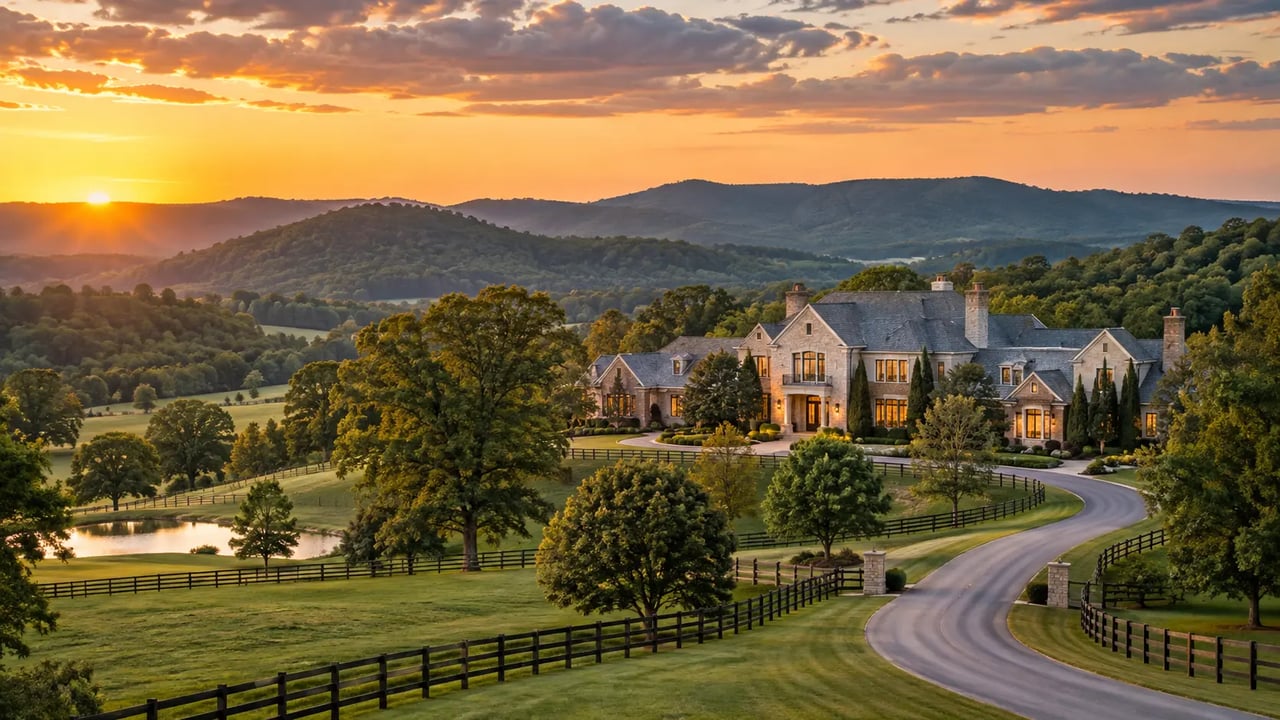
The most compelling opportunities are not necessarily the most expensive. They are the properties capable of remaining useful, distinctive, and manageable across generations. We currently have one available and you can preview it HERE.
What Is a Legacy Property?
A legacy property is real estate acquired with a time horizon extending beyond the immediate owner.
It may be a country estate where several generations gather for holidays. It may be a farm that continues supporting agricultural use. It could be timberland managed for recreation and conservation, or an estate large enough to accommodate separate homes for children and grandchildren.
What defines a legacy property is not simply price.
A true legacy asset often combines several characteristics:
- A durable location
- Meaningful privacy
- Quality land
- Scarcity
- Multiple potential uses
- Long-term family relevance
- Manageable operating requirements
- A clear succession strategy
A luxury home may be designed around the preferences of one owner.
A legacy property must often work for people who have not yet inherited it.
Luxury Property vs. Legacy Property
Luxury describes what a property offers today.
Legacy describes what it may continue to offer tomorrow.
That distinction changes the questions a family office should ask.
Can additional residences eventually be built?
Can agricultural or forestry uses continue?
Could part of the property be conserved?
Is the estate adequately protected from surrounding development?
Are access rights secure?
Would the property remain financially manageable if ownership were divided among several heirs?
Could one family member exit ownership without forcing an immediate sale?
These questions turn a real estate purchase into a long-term stewardship decision.
Why Tennessee Appeals to Family Offices
Tennessee offers unusual geographic diversity within a relatively compact state.
Buyers can choose among metropolitan luxury markets, rolling Middle Tennessee farmland, forested mountain property, lakefront retreats, equestrian estates, agricultural holdings, and recreational acreage.
This range allows families to align real estate closely with the purpose of the acquisition.
Privacy With Practical Access
Privacy is often a major priority for family offices, but remoteness and privacy are not the same thing.
A property can be beautifully secluded yet impractical if every trip to an airport, hospital, school, restaurant, or professional office becomes difficult.
For that reason, sophisticated buyers frequently evaluate properties according to both seclusion and connectivity.
Important considerations may include:
- Commercial airport access
- Private aviation
- Major highways
- Healthcare
- Professional services
- Schools and universities
- Restaurants and hospitality
- Estate staffing availability
- Proximity to business centers
For many families, the ideal Tennessee estate offers controlled access rather than isolation.
Lifestyle and Multigenerational Use
Tennessee land can support a wide range of activities, including:
- Equestrian pursuits
- Hunting
- Fishing
- Farming
- Forestry
- Hiking
- Wildlife management
- Outdoor entertaining
- Family retreats
- Guest accommodations
- Primary residences
- Seasonal residences
Properties capable of supporting several uses may remain relevant longer than those built around a single lifestyle.
Where Family Offices Look for Luxury and Legacy Properties in Tennessee
There is no single Tennessee market that serves every family-office objective.
The right location depends on how the family expects to use the property.
Nashville and Davidson County
Nashville is a logical starting point for buyers who prioritize access to business, healthcare, restaurants, entertainment, private services, and air travel.
Luxury inventory can include architecturally significant homes, gated estates, and substantial properties in established residential areas.
For principals who expect their Tennessee residence to function as a primary home or business base, Nashville offers convenience that remote acreage cannot replicate.
The trade-off is land availability.
Families seeking substantial acreage may need to widen their search beyond the urban core.
Belle Meade and Established Estate Areas
Belle Meade and surrounding areas appeal to buyers seeking mature landscaping, architectural character, large residential lots, and proximity to central Nashville.
These properties may offer a different type of scarcity from rural land.
Rather than hundreds of acres, value may be driven by location, neighborhood character, privacy, architecture, and the limited availability of significant estate properties.
Williamson County, Franklin and Brentwood
Williamson County remains important for luxury buyers seeking more space while maintaining access to Nashville.
Franklin and Brentwood offer established high-end residential markets, while more rural portions of the county can provide larger parcels, equestrian opportunities, and estate-scale settings.
For a family office, the core question is often how much additional privacy and acreage justify moving farther from Nashville.
Leiper’s Fork and Rural Middle Tennessee
Leiper’s Fork and nearby countryside can appeal to families drawn to rolling acreage, rural character, historic landscapes, and privacy.
A high-quality property may combine:
- Pasture
- Mature trees
- Creeks
- Barns
- Guest houses
- Riding areas
- Long driveways
- Significant road setbacks
Exceptional land can be difficult to reproduce, making scarcity an important part of the acquisition analysis.
Middle Tennessee Beyond the Core
Families prioritizing land over proximity may expand their search into other Middle Tennessee counties.
Larger tracts can provide opportunities for farming, recreation, equestrian use, conservation, or future family compounds.
As the search moves farther from Nashville, however, infrastructure becomes more important.
Buyers should pay close attention to roads, utilities, internet service, emergency services, healthcare access, local regulations, and future development patterns.
East Tennessee
East Tennessee offers a different landscape and lifestyle.
The region includes Knoxville, Chattanooga, mountain environments, forested acreage, river settings, and access to significant outdoor recreation.
Families looking for scenic property, wooded estates, recreation, or retreat-oriented ownership may find opportunities substantially different from those in Middle Tennessee.
Lake and Mountain Properties
Lakefront and mountain properties can be particularly attractive as second homes and family retreats.
They also demand specialized due diligence.
Potential issues can include:
- Shoreline restrictions
- Dock approvals
- Slope stability
- Road access
- Septic capacity
- Erosion
- Flood exposure
- Utility infrastructure
- Insurance
- Seasonal maintenance
A dramatic view should never substitute for technical investigation.
West Tennessee
West Tennessee can offer both urban luxury residences and substantial agricultural holdings.
Families considering larger tracts should evaluate soils, water, drainage, farming history, access, and operating infrastructure carefully.
For agricultural property, the land may ultimately matter far more than the residence.
The Major Property Types Family Offices Evaluate
Before looking at listings, a family office should determine what type of asset best supports the family’s objectives.
Signature Luxury Residences
These properties are primarily residential assets.
Their value may be driven by:
- Architecture
- Design
- Location
- Amenities
- Privacy
- Landscaping
- Quality of construction
They may suit principals seeking a sophisticated primary residence or second home without the operational complexity of extensive acreage.
The primary consideration is often resale depth. Highly personalized homes may appeal to a narrow future buyer pool.
Large-Acreage Estates
Acreage can create privacy, recreation, security, and future flexibility.
It can also dramatically increase management requirements.
Large holdings may involve:
- Internal roads
- Fencing
- Ponds
- Timber
- Pastures
- Drainage systems
- Outbuildings
- Equipment
- Invasive vegetation
- Wildlife management
- Staff
Family offices should evaluate acreage as an operating asset, not merely as scenery.
Farms and Agricultural Properties
Working farms require a different level of underwriting from conventional homes.
Relevant factors can include:
- Soil quality
- Water
- Fencing
- Barns
- Equipment storage
- Leases
- Farm operators
- Crop history
- Livestock infrastructure
- Land classification
Families should decide whether farming is intended to generate income, maintain the property, preserve its character, support a lifestyle, or accomplish several of those goals simultaneously.
Equestrian Estates
Equestrian properties are highly specialized.
An attractive barn does not necessarily make an estate functionally suitable for horses.
Buyers should evaluate:
- Pasture quality
- Fencing
- Paddocks
- Arenas
- Drainage
- Water
- Trailer access
- Barn ventilation
- Feed storage
- Veterinary access
- Staff housing
The entire operating system matters.
Timber and Forest Property
Forested land can provide privacy, habitat, recreation, and potentially timber value.
Professional forestry analysis may be appropriate when timber represents a meaningful part of the acquisition.
Important questions include:
- What species are present?
- How mature is the timber?
- Has the land been harvested previously?
- Are internal roads adequate?
- Is the terrain accessible?
- What management will be required?
Hunting and Recreational Land
Recreational land should be evaluated according to the experience it can actually support.
Consider:
- Habitat quality
- Water sources
- Food sources
- Neighboring land uses
- Trail systems
- Access
- Wildlife management history
- Topography
A visually attractive tract is not automatically a strong recreational asset.
Waterfront and Lake Properties
Waterfront ownership can deliver exceptional lifestyle value, but it also introduces complexity.
Family offices should investigate:
- Shoreline conditions
- Dock rights
- Access
- Flood exposure
- Water-level fluctuations
- Erosion
- Utility infrastructure
- Insurance
- Maintenance obligations
Family Compounds
For some buyers, the ideal legacy property is designed around several generations.
A family compound may include:
- Main residence
- Guest house
- Caretaker residence
- Cabins
- Future homesites
- Shared recreation areas
- Agricultural buildings
Before assuming additional homes can be created, buyers should verify zoning, access, septic capacity, subdivision restrictions, utilities, and building regulations.
How Should a Family Office Evaluate a Tennessee Property?
A disciplined acquisition process begins with strategy.
Start With the Family’s Objective
Before evaluating a property, define why the family wants it.
Is it primarily:
- A residence?
- A retreat?
- A family gathering place?
- A farm?
- An investment?
- A recreational holding?
- A conservation asset?
- A future compound?
- A multigenerational legacy property?
A clear objective prevents buyers from confusing an impressive property with the right property.
Evaluate the Land Before the House
For large-acreage purchases, the home is only one component.
The land should often receive equal or greater scrutiny.
Evaluate:
- Topography
- Soil
- Drainage
- Streams
- Springs
- Ponds
- Timber
- Pasture
- Road frontage
- Internal roads
- Utilities
- Easements
- Neighboring uses
A beautifully renovated residence cannot compensate for fundamentally unsuitable land.
Evaluate Long-Term Optionality
Optionality is one of the most valuable characteristics of a generational property.
Ask what the property could support twenty or thirty years from now.
Could the family:
- Build additional residences?
- Divide part of the land?
- Expand agricultural activity?
- Add barns or recreational structures?
- Protect part of the property through conservation?
- Change uses as family needs evolve?
A legacy asset should ideally preserve intelligent choices for future owners.
Understand the Carrying Costs
Purchase price is only the beginning.
Major estates may require ongoing expenditures for:
- Property taxes
- Insurance
- Staffing
- Security
- Utilities
- Landscaping
- Farm operations
- Fencing
- Roads
- Roofing
- Barns
- Equipment
- Water systems
- Tree management
- Capital improvements
Family offices should develop both an annual operating budget and a long-range capital expenditure plan.
Consider Liquidity
A property can be an excellent long-term holding while still having limited liquidity.
Very large tracts, unusual architecture, and highly customized compounds may appeal to a small future buyer pool.
Even if the family expects to hold indefinitely, it should understand what an eventual exit could look like.
Due Diligence for Tennessee Luxury Homes and Land
Luxury does not reduce the need for rigorous due diligence.
In many cases, higher complexity makes it more important.
Title, Boundaries and Easements
Review:
- Title
- Surveys
- Easements
- Encroachments
- Rights-of-way
- Boundary lines
- Access agreements
Older rural properties may have access arrangements or legal descriptions that require particular attention.
Water, Wells, Springs and Ponds
Water availability can significantly affect long-term utility.
Buyers should determine whether existing resources can support:
- Residential demand
- Livestock
- Irrigation
- Agricultural activity
- Additional residences
- Recreational features
Septic and Utility Capacity
A property may adequately support its current residence but lack infrastructure for future expansion.
Before planning guest houses or additional homes, investigate whether septic, water, electricity, internet, and road systems can support them.
Road Access
Determine:
- Whether roads are public or private
- Whether access is legally recorded
- Who maintains shared roads
- Whether emergency vehicles can reach the property
- Whether large equipment and trailers can enter easily
Beautiful land with poor access can become difficult to operate.
Flood, Drainage and Environmental Conditions
A property can look entirely different after heavy rain.
Investigate:
- Flood exposure
- Drainage
- Wet areas
- Slope conditions
- Erosion
- Environmental constraints
This becomes especially important when future construction is contemplated.
Mineral, Timber and Other Rights
Ownership of the surface may not always include every associated right.
Buyers should understand whether timber, mineral, access, or other interests have previously been conveyed or encumbered.
Zoning and Development Restrictions
Do not assume that acreage can be used however the family wishes.
Local restrictions may affect:
- Additional residences
- Subdivision
- Agricultural buildings
- Commercial activities
- Events
- Short-term rentals
- Accessory structures
- Conservation plans
If a future use is important to the acquisition thesis, verify it before closing.
Tennessee Greenbelt and Land-Use Planning
Tennessee’s Greenbelt program can be relevant for qualifying agricultural, forest, and open-space property.
In general, eligible land may be valued based on qualifying present use rather than purely on development-oriented market value.
For owners of substantial acreage, that can materially affect property-tax economics.
However, acreage alone does not guarantee eligibility.
A family office should verify the property’s existing status, determine whether applicable requirements are satisfied, and understand what may happen if the property changes ownership or use.
Greenbelt Is Not the Same as a Conservation Easement
These concepts are often confused.
They are different.
Greenbelt involves qualifying land use and property valuation.
A conservation easement is a legal restriction designed to protect defined conservation characteristics of a property.
Depending on the structure, an easement may restrict development for a very long period or permanently.
Family offices should understand exactly what future rights are being retained and what rights are being relinquished.
Conservation as a Legacy Strategy
For stewardship-oriented families, conservation can become an important part of the property’s long-term purpose.
A family may wish to protect:
- Farmland
- Forest
- Wildlife habitat
- Scenic views
- Water resources
- Historic landscapes
Conservation can align closely with legacy goals when the intention is to preserve the essential character of land for future generations.
Preserving Working Land
Preservation does not necessarily mean eliminating productive use.
Some conservation strategies can allow qualifying agricultural or forestry activity to continue while restricting incompatible development.
For families that want land to remain open, productive, and privately held, this approach can be compelling.
Understand the Trade-Off
Conservation can preserve what makes a property special.
It can also reduce future flexibility.
A permanent restriction created by one generation can affect descendants who have different needs.
For that reason, conservation decisions should be coordinated with legal, tax, land, and family-governance advisors.
Ownership Structures and Family Governance
How a property is owned can be almost as important as which property is acquired.
Depending on the family, ownership may involve:
- Individuals
- Trusts
- Limited liability companies
- Family entities
- Combinations of structures
There is no universal solution.
The structure should be evaluated in light of estate planning, governance, liability, privacy, financing, and tax objectives.
Define Who Makes Decisions
Family properties become difficult when authority is unclear.
Who decides:
- Whether to renovate?
- Whether to sell?
- Whether to conserve land?
- Whether to hire staff?
- How guests may use the property?
- Whether agricultural operations continue?
- How much each owner contributes?
- Whether additional residences may be constructed?
These questions become more complicated when ownership eventually passes to several descendants.
Create a Written Governance Framework
A family property policy can address:
- Usage rights
- Scheduling
- Guest privileges
- Operating expenses
- Capital contributions
- Improvements
- Leasing
- Agricultural activity
- Transfers
- Buyouts
- Sale procedures
- Dispute resolution
The purpose is not to make family life bureaucratic.
It is to prevent ambiguity from becoming conflict.
Estate and Succession Planning for Legacy Properties
Tennessee does not currently impose its former state inheritance tax for deaths occurring in 2016 or later, but that does not eliminate the need for sophisticated estate planning.
Federal tax considerations, ownership structure, valuation, liquidity, family governance, and individual circumstances can remain highly relevant.
A legacy property only becomes truly generational if the transfer plan works.
Plan Before Ownership Changes
Passing a large property equally to several heirs can create immediate challenges.
One heir may want to live there.
Another may want rental income.
A third may prefer to sell.
A fourth may be unwilling or unable to contribute toward maintenance.
These scenarios should be addressed while the original owner can still define expectations.
Equal Ownership Is Not Always the Most Practical Outcome
Real estate is difficult to divide.
A family may determine that balancing real property against other assets creates more flexibility than dividing every asset equally.
The correct approach depends on the family’s circumstances and should be developed with qualified estate-planning professionals.
Plan for Future Operating Expenses
A property that is inexpensive relative to the founder’s wealth may be costly for future beneficiaries.
Families should determine how later generations will pay for:
- Property taxes
- Insurance
- Staff
- Maintenance
- Capital improvements
- Agricultural operations
- Security
Ownership without funding can turn a cherished estate into a financial burden.
Create an Exit Process
Even families committed to long-term ownership should establish procedures for a future exit.
Consider:
- What happens if one owner wants to sell?
- Do other family members receive a purchase option?
- How will an ownership interest be valued?
- Can interests be transferred outside the family?
- What voting threshold is required to sell the entire property?
Addressing these issues early can protect both family relationships and the asset itself.
Privacy and Security for High-Net-Worth Buyers
Privacy should be treated as part of acquisition strategy rather than an afterthought.
Transaction Privacy
Family offices may prefer controlled disclosure during property searches, negotiations, and closing.
Advisors should understand confidentiality expectations from the beginning.
Physical Privacy
A gate does not guarantee privacy.
Evaluate:
- Road visibility
- Sightlines
- Neighboring parcels
- Tree buffers
- Future development
- Public access points
In some cases, owning additional surrounding acreage may protect privacy more effectively than retrofitting security later.
Digital and Operational Security
Luxury estates increasingly rely on connected technology.
Security planning may involve:
- Cameras
- Gates
- Smart-home systems
- Network security
- Remote monitoring
- Vendor access
- Staff procedures
Cybersecurity and physical security should be considered together.
Operating a Legacy Estate
Large properties frequently operate more like small businesses than conventional homes.
Depending on the asset, the team might include:
- Estate manager
- Caretaker
- Household staff
- Farm manager
- Forester
- Grounds crew
- Equestrian professionals
- Security personnel
- Specialized contractors
Family offices should determine what should be managed internally and what can be outsourced.
Preventive Maintenance Protects Capital
Deferred maintenance can compound rapidly.
A small drainage issue may damage a private road.
A leaking barn roof can destroy equipment.
A neglected pond can become expensive to restore.
Unmanaged trees can threaten structures.
Preventive maintenance is not simply an operating expense. It is part of asset preservation.
Off-Market and Private-Market Opportunities
Some exceptional Tennessee legacy properties may never receive broad public exposure.
Owners of historic estates, longstanding family farms, or highly private holdings may prefer discreet transactions.
Relationships can therefore play a meaningful role.
Potential sources of opportunities can include:
- Luxury brokers
- Land specialists
- Attorneys
- Wealth advisors
- Estate planners
- Local landowners
- Agricultural professionals
Off-Market Does Not Mean Lower Due Diligence
Scarcity can create urgency.
It should not weaken underwriting standards.
A private opportunity still requires full review of:
- Title
- Access
- Boundaries
- Structures
- Land
- Environmental conditions
- Taxes
- Restrictions
- Operating economics
Rare does not automatically mean suitable.
What Makes a Tennessee Property Truly Generational?
A practical family-office framework is to evaluate a property across ten dimensions.
1. Location Durability
Will the location remain useful as family circumstances evolve?
2. Land Quality
Does the acreage provide real utility rather than simply scale?
3. Privacy
Can privacy be maintained over time?
4. Scarcity
How difficult would it be to replace the property?
5. Multiple Uses
Can the estate support residential, agricultural, recreational, or conservation objectives?
6. Sustainable Carrying Costs
Can the family maintain the asset without strain?
7. Environmental Resilience
Are water, drainage, terrain, and natural systems well understood?
8. Family Relevance
Will future generations actually want to spend time there?
9. Succession Feasibility
Can ownership transition without creating an unmanageable structure?
10. Long-Term Optionality
Does the property preserve meaningful choices for future owners?
The objective is not perfection.
It is alignment.
Common Mistakes Family Offices Should Avoid
Underwriting the House but Not the Land
With acreage, the land can ultimately matter more than the residence.
Assuming Current Family Preferences Will Never Change
Future generations may have different lifestyles, careers, and priorities.
Flexibility has value.
Ignoring Access and Easement Issues
Small legal complications can become significant when property use changes.
Underestimating Operating Costs
An estate can consume substantial capital even without debt.
Assuming Future Development Will Be Allowed
Verify what can legally be built, divided, or changed.
Separating Tax Planning From Property Planning
Ownership, succession, land classification, conservation, and tax planning can overlap significantly.
Waiting Too Long to Establish Governance
A governance framework is easiest to create while the original decision-makers can clearly communicate their intentions.
Building the Right Advisory Team
Complex Tennessee acquisitions frequently require more than a traditional residential real estate team.
Depending on the property, a family office may involve:
Luxury or Land Real Estate Advisor
Sources opportunities and provides local market context.
Real Estate Attorney
Reviews contracts, title, easements, restrictions, and access.
Estate-Planning Counsel
Coordinates ownership and succession strategy.
CPA or Tax Advisor
Evaluates tax implications and ownership economics.
Surveyor
Confirms boundaries and potential encroachments.
Civil Engineer
Assesses infrastructure and development feasibility.
Agricultural, Forestry or Environmental Specialists
Evaluate land quality, operations, natural resources, or conservation issues.
Insurance and Risk Advisor
Evaluates coverage for buildings, land, equipment, staff, and specialty activities.
Estate Manager
Coordinates long-term operation after closing.
The more complex the property, the more valuable coordinated advice becomes.
Family Office Checklist for Buying a Tennessee Legacy Property
Before acquiring a Tennessee luxury home, landholding, or legacy estate, ask:
Purpose: Why is the family buying it?
Location: Does it balance access and privacy?
Acreage: Is the land useful?
Residence: Does the home support the family’s real needs?
Land: Are soil, water, timber, drainage, and topography understood?
Title: Are ownership and restrictions clear?
Boundaries: Has the property been properly surveyed?
Access: Is legal and practical access secure?
Utilities: Can infrastructure support future plans?
Zoning: Are intended uses allowed?
Taxes: What will annual ownership cost?
Greenbelt: Does qualifying land receive or potentially qualify for use-based valuation?
Operations: What staff and management will be required?
Conservation: Should any part of the property be permanently protected?
Ownership: How should the asset be held?
Succession: How will it pass to future generations?
Governance: Who makes decisions?
Security: How will physical and digital privacy be managed?
Liquidity: Who might buy it if the family eventually sells?
Optionality: What choices remain available twenty years from now?
Frequently Asked Questions
What makes a property a legacy property?
A legacy property is generally acquired with a multigenerational purpose. It often combines residence, land, privacy, family use, recreation, agriculture, conservation, or long-term stewardship. Its importance extends beyond current market value.
Where are the major luxury real estate markets in Tennessee?
Nashville, Belle Meade, Brentwood, Franklin, Williamson County, parts of East Tennessee, lake communities, mountain markets, Memphis, and selected rural areas all offer different forms of luxury and legacy real estate.
Is Tennessee suitable for large family estates?
Yes. Tennessee offers agricultural, equestrian, forested, recreational, waterfront, mountain, and large-acreage properties across several regions. Suitability depends on the family’s objectives and required infrastructure.
What should a family office investigate before buying Tennessee land?
Key considerations include title, surveys, access, easements, water, soil, drainage, utilities, timber, zoning, neighboring uses, environmental conditions, operating costs, taxes, and development restrictions.
What is Tennessee Greenbelt?
Greenbelt is Tennessee’s use-value framework for qualifying agricultural, forest, and open-space land. Eligible acreage may be valued according to qualifying present use rather than solely according to market development potential.
Can a luxury estate include Greenbelt land?
Potentially. A luxury residence can be part of a larger holding that includes qualifying agricultural, forest, or open-space acreage. Eligibility should be confirmed rather than assumed.
Is Greenbelt the same as a conservation easement?
No. Greenbelt concerns qualifying land use and property valuation. A conservation easement is a legal restriction intended to protect identified conservation values and may impose long-term or permanent limitations on development.
Should a family office hold Tennessee property in an LLC or trust?
There is no single correct structure. The answer depends on liability, governance, privacy, estate planning, financing, and tax considerations. Legal and tax advisors should review the structure before closing.
Does Tennessee have an inheritance tax?
Tennessee no longer imposes its former state inheritance tax for deaths occurring in 2016 or later. However, federal estate-planning considerations and other tax issues can still be important for high-net-worth families.
How can a family keep an estate for multiple generations?
Long-term ownership generally requires thoughtful succession planning, governance, operating reserves, clear usage rules, transfer provisions, buyout procedures, and a realistic plan for ongoing maintenance.
Conclusion: Buy for Today, Underwrite for Generations
The best Tennessee property for a family office is not necessarily the largest estate, the most expensive residence, or the most recognizable address.
It is the property that best aligns with the family’s purpose.
For one family, that may be an architecturally significant Nashville residence close to business and cultural life.
For another, it may be a Williamson County estate surrounded by rolling pasture.
For another, it could be a working farm, forested recreational tract, lake retreat, mountain property, or multigenerational compound.
Whatever form it takes, a genuine legacy asset should be evaluated through a longer lens.
The residence matters.
The land matters.
The operating costs matter.
The ownership structure matters.
The succession strategy matters.
And the ability of future generations to use, adapt, preserve, and enjoy the property may matter most of all.
For family offices evaluating luxury homes, land, and legacy properties in Tennessee, the guiding principle is simple:
Buy for today. Underwrite for generations.