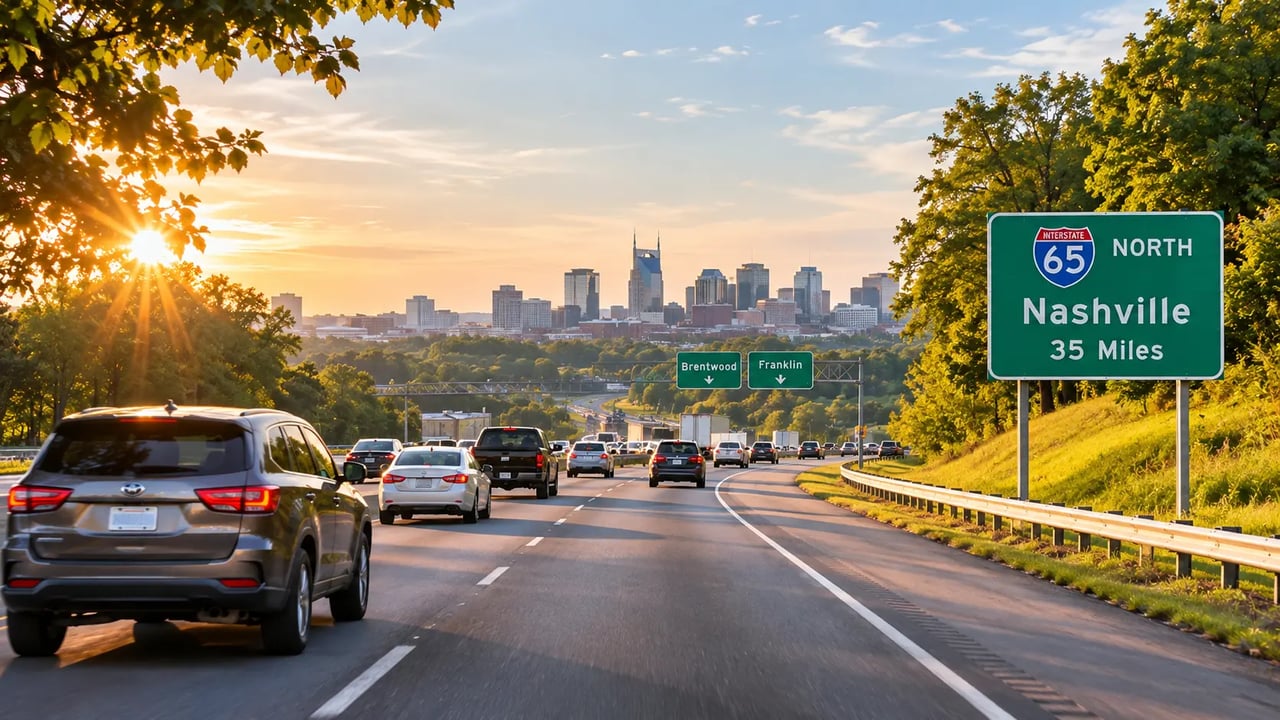
Spring Hill to Nashville Commute: Drive Times, Traffic & Tips for 2027
Thinking about moving to Spring Hill, Tennessee, but wondering what the daily commute to Nashville will be like? You're not alone. For many homebuyers relocating to Middle Tennessee, one of the biggest questions isn't just where to buy a home, but how much time they'll spend traveling to work every day.
Spring Hill has become an attractive option for people seeking newer homes, established neighborhoods, additional living space, and convenient access to communities throughout the Greater Nashville area. Located approximately 30 miles south of Nashville, Spring Hill offers a suburban lifestyle while remaining connected to the region's major employment centers.
But there's one important consideration: the Spring Hill to Nashville commute can vary significantly depending on traffic, your exact neighborhood, and where you work.
A drive that takes 40 minutes under favorable conditions could require an hour or longer during busy commuting periods.
Fortunately, understanding the main commuting routes, traffic patterns, transportation options, and potential expenses can help you decide whether living in Spring Hill and working in Nashville makes sense for your lifestyle.
This comprehensive Spring Hill to Nashville commute guide for 2027 explains realistic driving times, Interstate 65 traffic, alternative routes, commuting costs, and practical tips for homebuyers considering a move to Spring Hill, TN.
How Long Does It Take to Drive From Spring Hill to Nashville?
The commute from Spring Hill to downtown Nashville typically takes approximately 35 to 60 minutes under favorable to moderately congested driving conditions. During heavy rush-hour traffic, the drive can take 60 to 75 minutes or longer.
However, those times are planning estimates rather than guaranteed travel durations.
Your actual commute depends on several factors:
- Your starting neighborhood in Spring Hill.
- Your workplace location in Nashville.
- The time you leave home.
- Traffic conditions on Interstate 65.
- Road construction and accidents.
- Weather conditions.
- Local traffic near your home and workplace.
For example, someone living near the Buckner Road interchange may have a different commute from someone living farther west of Interstate 65.
Similarly, commuting to an office in Brentwood or Cool Springs can be considerably shorter than driving all the way into downtown Nashville.
Spring Hill to Nashville Area Commute Times
The following estimates provide a general starting point for planning your commute in 2027.
Destination | Approximate One-Way Drive |
|---|---|
Downtown Franklin | 20–35 minutes |
Cool Springs | 20–35 minutes |
Brentwood | 30–45 minutes |
Downtown Nashville | 35–60+ minutes |
Nashville International Airport | 45–70+ minutes |
These are approximate travel-time ranges, not live traffic measurements or confirmed 2027 forecasts. Heavy congestion can push actual travel times beyond these estimates.
For commuters traveling five days per week, even small differences in driving time can add up quickly.
That's why it's important to test your commute from a specific property address rather than relying on general city-to-city driving estimates.
Best Routes From Spring Hill to Nashville
Spring Hill residents have several options for traveling north toward Nashville, Franklin, and Brentwood.
The best route depends on where you live, where you're going, and current traffic conditions.
1. Interstate 65 North: The Primary Nashville Commuting Route
Interstate 65 is the main north-south highway connecting Spring Hill with Franklin, Brentwood, and Nashville.
For many residents, I-65 provides the most direct highway route to major employment centers throughout the region.
Drivers can access the interstate from Spring Hill using Saturn Parkway or the Buckner Road interchange near the June Lake development.
Once on I-65 North, commuters travel toward Interstate 840, Franklin, Cool Springs, Brentwood, and eventually Nashville.
Advantages of commuting on I-65:
- Direct connections to major employment centers.
- Interstate access to Franklin and Brentwood.
- Multiple connections to Nashville's highway network.
- Generally efficient travel during lighter traffic periods.
Potential disadvantages:
- Significant congestion during rush hour.
- Delays near busy interchanges.
- Accidents that can affect traffic over long distances.
- Construction activity and temporary lane restrictions.
If your workplace is in downtown Nashville, I-65 will likely be one of the first routes you consider.
However, the fastest route can change throughout the day.
2. US-31 / Columbia Pike: An Alternative North–South Route
US Highway 31, also known as Columbia Pike in much of the area, is another important transportation corridor connecting Spring Hill with communities farther north.
Unlike Interstate 65, US-31 includes traffic signals, commercial areas, intersections, and lower speed limits.
For certain destinations in Thompson's Station or Franklin, it may provide a practical alternative to the interstate.
When might US-31 make sense?
- Your home is located near Main Street in Spring Hill.
- Your workplace is in southern or central Franklin.
- You need access to neighborhoods along the corridor.
- Traffic conditions make an alternative route worth considering.
However, US-31 is not automatically faster when I-65 becomes congested.
Traffic signals and local development can create delays of their own.
Use current navigation information when deciding which route is best.
3. Saturn Parkway: Connecting Spring Hill to I-65
Saturn Parkway, also known as State Route 396, is an important access road for many Spring Hill residents.
It connects parts of the city with Interstate 65 at Exit 53.
For commuters living in areas served by Port Royal Road, Kedron Road, and nearby streets, Saturn Parkway can be a convenient route toward the interstate.
When comparing homes, consider not just the distance to I-65 but how long it takes to reach the interstate from your driveway.
A property that appears conveniently located may still require navigating several busy intersections before reaching the highway.
4. Buckner Road and the June Lake Interchange
The Interstate 65 interchange at Buckner Road, also associated with June Lake Boulevard, opened in May 2024.
This interchange provides Spring Hill with another important connection to I-65.
Before it opened, Saturn Parkway served as the city's primary direct interstate access point.
The Buckner Road interchange can be especially relevant for residents living in northern and eastern Spring Hill neighborhoods.
For homebuyers exploring areas near June Lake and Buckner Road, access to this interchange may be an important commuting consideration.
However, convenient interstate access does not eliminate congestion farther north.
5. Interstate 840: A Useful Regional Connection
Interstate 840 connects I-65 with other parts of Middle Tennessee.
Although I-840 is not usually the primary route into downtown Nashville, it can be useful for commuters traveling toward other regional destinations.
For example, drivers working in areas east or west of the main I-65 corridor may benefit from connections provided by I-840.
The best route should always be evaluated using the exact workplace address.
Spring Hill to Nashville Rush Hour Traffic: What to Expect
Traffic is one of the most important factors to consider when deciding whether to live in Spring Hill and commute to Nashville.
The I-65 corridor serves residents traveling between multiple communities, creating substantial demand during weekday commuting periods.
Morning Rush Hour
On a typical weekday, northbound traffic toward Nashville becomes busier as commuters travel to workplaces in Franklin, Brentwood, and Nashville.
Congestion can develop around major interchanges and continue farther north as traffic volumes increase.
For planning purposes, drivers should pay particular attention to conditions between approximately 6:30 AM and 9:00 AM.
These are general rush-hour planning windows rather than fixed daily congestion schedules.
Evening Rush Hour
The afternoon commute often involves heavier southbound travel as workers return from Nashville, Brentwood, and Franklin.
Traffic can become challenging between approximately 3:30 PM and 6:30 PM, with some days experiencing delays outside those hours.
Accidents, weather, sporting events, and construction may increase congestion.
Why Weekend Drive Times Can Be Misleading
One of the biggest mistakes prospective Spring Hill homebuyers make is testing the drive to Nashville only on a Saturday or Sunday.
Weekend traffic patterns may be very different from those on a typical workday.
A route that takes 40 minutes on a Sunday afternoon might take considerably longer during a Tuesday morning commute.
Homebuyer tip: If possible, drive from a prospective Spring Hill home to your workplace during the actual hours you expect to commute. Repeat the trip in the opposite direction after work.
This provides a much more useful picture of your potential daily routine.
Can You Take Public Transportation From Spring Hill to Nashville?
Yes. Spring Hill residents have access to a regional commuter bus option through WeGo Public Transit.
WeGo Route 95: Spring Hill–Franklin
WeGo Route 95 connects Spring Hill and Franklin with Nashville on scheduled weekday commuter trips.
The route includes a Spring Hill park-and-ride location and stops serving destinations in Nashville.
Some trips also serve the Vanderbilt University Medical Center area.
For people who work near the route's stops and maintain predictable schedules, commuter bus service may be worth considering.
What to Know Before Choosing the Bus
The commuter route has a limited operating schedule.
Based on the published late-2026 service pattern, Route 95 operates on weekdays, primarily with northbound morning trips and southbound afternoon trips.
Weekend and holiday service is not part of that published pattern.
Schedules, stops, fares, and detours may change during 2027.
Before relying on the service, verify the current timetable and consider how you would get from the bus stop to your workplace.
Is Public Transportation Better Than Driving?
That depends on your circumstances.
Commuter bus advantages:
- Less time spent personally driving.
- Potential savings on parking expenses.
- Reduced vehicle mileage.
- An opportunity to read or relax during the ride.
Potential disadvantages:
- Limited departure times.
- Travel schedules that may not match flexible work hours.
- Additional travel needed between stops and workplaces.
- Limited alternatives if you miss a return trip.
For commuters with traditional downtown office schedules, Route 95 may be a practical option.
For those with irregular hours or workplaces far from its stops, driving may offer greater flexibility.
How Much Does It Cost to Commute From Spring Hill to Nashville?
Commuting expenses are an important part of your household budget.
Even if Spring Hill offers a home that fits your needs, transportation costs can influence the overall affordability of living there.
Your total commuting cost may include:
- Gasoline.
- Vehicle maintenance.
- Tire replacement.
- Vehicle depreciation.
- Parking fees.
- Toll or other route-specific charges, where applicable.
- Additional transportation expenses.
Example Monthly Commuting Budget
Consider a hypothetical commuter who drives approximately 70 miles round-trip between Spring Hill and Nashville.
Assume the person commutes 22 days per month and averages 28 miles per gallon.
Expense Calculation | Example |
|---|---|
Daily round-trip distance | 70 miles |
Monthly commuting days | 22 |
Monthly distance | 1,540 miles |
Vehicle fuel efficiency | 28 MPG |
Estimated gasoline use | 55 gallons |
Assumed gasoline price | $3.25 per gallon |
Estimated monthly fuel cost | $179 |
This example illustrates fuel expenses only, using hypothetical mileage, fuel economy, and gasoline prices. It is not a forecast of 2027 fuel prices.
Parking, maintenance, tires, and vehicle depreciation can add substantially to your overall costs.
The Hidden Cost: Time
Commuting also requires time that could otherwise be spent at home or participating in other activities.
If your average one-way commute is 50 minutes, your approximate round-trip driving time is 100 minutes.
For someone commuting 22 days per month, that's nearly 37 hours per month spent traveling between home and work.
Over a full working year, that time commitment becomes substantial.
It doesn't necessarily mean the commute is unreasonable, but it deserves consideration when comparing communities.
How Hybrid Work Can Reduce Commuting Expenses
A hybrid work arrangement may make living in Spring Hill more attractive.
For example, commuting three days per week rather than five reduces the number of weekly trips by 40%.
That can mean fewer miles on your vehicle, lower fuel expenses, and more time available for personal activities.
If your employer offers remote or flexible work options, include those arrangements in your housing decision.
Is Living in Spring Hill and Working in Nashville Worth It?
For many homebuyers, the decision comes down to balancing housing preferences with commuting demands.
Spring Hill may be appealing if you want a residential environment, access to newer construction, or a particular combination of home features and amenities.
However, longer daily travel times may be an important trade-off.
Advantages of Living in Spring Hill
Housing variety: Spring Hill includes established subdivisions, townhomes, newer construction, and residential properties with different layouts and lot sizes.
Residential amenities: Many neighborhoods offer access to local parks, shopping, restaurants, and community facilities.
Access to multiple employment areas: Residents can commute toward Franklin, Cool Springs, Brentwood, Nashville, and other parts of the region.
More options for homebuyers: Comparing Spring Hill with communities farther north may reveal different combinations of home size, neighborhood features, and price.
Potential Disadvantages
Longer Nashville commute: Daily travel to downtown Nashville can consume significant time, especially during rush hour.
Traffic unpredictability: Accidents and congestion on I-65 may cause delays.
Vehicle expenses: Longer drives can increase fuel usage, mileage, and maintenance costs.
Schedule limitations: Commuting may affect evening activities and the amount of time available at home.
Who Might Find Spring Hill a Good Fit?
Spring Hill may work particularly well for buyers who:
- Work in Franklin, Cool Springs, or southern Brentwood.
- Have flexible or hybrid work schedules.
- Are comfortable with a longer drive in exchange for preferred housing features.
- Want to explore suburban communities south of Nashville.
- Have considered commute expenses in their overall budget.
Ultimately, whether the Spring Hill to Nashville commute is worth it depends on your individual priorities.
Best Areas of Spring Hill for Nashville Commuters
Not every Spring Hill neighborhood offers the same commuting experience.
For homebuyers planning to work in Nashville, location within the city can make a meaningful difference.
Neighborhoods Near Buckner Road and June Lake
Properties with convenient access to the Buckner Road interchange may offer useful connections to I-65 North.
For commuters who regularly travel toward Franklin, Brentwood, or Nashville, this access can be an important advantage.
However, proximity to the interchange should be evaluated alongside neighborhood traffic and actual drive times.
Areas Near Saturn Parkway
Neighborhoods with straightforward access to Saturn Parkway can provide a practical route toward I-65.
For buyers exploring central and southern parts of Spring Hill, this connection may be especially relevant.
Check how long it takes to reach Saturn Parkway during weekday morning traffic.
Homes Near US-31
Properties near Main Street or Columbia Pike may offer alternative travel options toward Thompson's Station and Franklin.
This can be useful if your workplace is located along the US-31 corridor.
However, the presence of traffic signals and commercial activity may make the route slower during peak periods.
Choosing a Home Based on Your Commute
Before making an offer, consider:
- How many minutes it takes to reach your preferred highway.
- Whether local intersections experience morning backups.
- Your likely commute during rush hour.
- Alternative routes if an accident blocks your usual drive.
- The distance to everyday amenities.
- Whether the property supports your longer-term lifestyle.
The best commuter neighborhood isn't necessarily the one closest to Nashville. It's the one that offers the most practical route to your actual workplace while meeting your housing needs.
Spring Hill vs. Franklin vs. Brentwood: Which Commute Is Better?
Many homebuyers exploring communities south of Nashville compare Spring Hill, Franklin, and Brentwood.
Each offers different residential environments, housing options, and commuting considerations.
Factor | Spring Hill | Franklin | Brentwood |
|---|---|---|---|
General location | South of Franklin | Central Williamson County | North of Franklin |
Downtown Nashville commute | Typically longest of the three | Moderate to long | Generally shortest |
Housing options | Established and newer homes | Historic, suburban, and luxury homes | Established subdivisions and luxury homes |
I-65 access | Saturn Parkway and Buckner Road | Multiple interchanges | Multiple interchanges |
Main consideration | Housing preferences vs. drive time | Balance of location and lifestyle | Nashville proximity vs. housing costs |
Spring Hill
Spring Hill may appeal to buyers who prioritize specific home features, neighborhood amenities, or newer residential development.
However, commuting to downtown Nashville typically involves more travel than starting from Franklin or Brentwood.
Franklin
Franklin offers a middle-ground location for some commuters.
It combines historic downtown amenities, established neighborhoods, shopping, and convenient access to business centers.
Travel times depend heavily on which part of Franklin you choose.
Brentwood
Brentwood is geographically closer to Nashville and may provide a shorter commute for workers traveling into the city.
However, housing costs in many Brentwood neighborhoods can be relatively high.
Which Community Should You Choose?
There's no single right answer.
If you work downtown five days per week, reducing commute time may be a major priority.
If you work remotely or travel to Cool Springs only a few days per week, Spring Hill may offer an attractive alternative.
Compare specific homes and commuting routes rather than choosing based on city names alone.
Will Road Improvements Make the Spring Hill Commute Better in 2027?
Transportation improvements are an important topic for people considering Spring Hill.
Population growth and residential development have increased demand on major roadways, especially Interstate 65.
Several infrastructure projects are intended to address transportation needs in the area.
Interstate 65 Widening Near Spring Hill
The Tennessee Department of Transportation has plans to widen a portion of I-65 between the area north of Saturn Parkway and Interstate 840.
The proposed improvements include additional travel capacity and changes intended to address congestion near key interchanges.
Under the project schedule available in late 2026, design and procurement activities are expected to continue during 2027, with construction targeted for 2028.
Homebuyers should not assume that this project will reduce commute times during 2027.
Project timelines can change, and construction itself may eventually create temporary traffic disruptions.
Buckner Road Interchange Improvements
The Buckner Road interchange opened in 2024, adding another direct connection between Spring Hill and Interstate 65.
This infrastructure provides additional access for nearby residential and commercial developments.
For commuters living in northern Spring Hill, it may offer a more convenient connection to the interstate.
Other Local Road Improvements
Additional roadway projects in and around Spring Hill may involve widening, intersection improvements, and construction along local corridors.
Such improvements can influence how residents travel between neighborhoods and major highways.
However, proposed construction schedules and expected traffic benefits should always be treated as subject to change.
What This Means for Homebuyers in 2027
When evaluating a Spring Hill property, consider the transportation network that exists today rather than relying on future improvements.
A home should make sense for your current commuting requirements, even if planned road projects are delayed.
Practical Tips for Making the Spring Hill to Nashville Commute Easier
A longer commute doesn't necessarily have to become a daily frustration.
With the right planning, you can make the journey more predictable and manageable.
1. Test Your Commute Before Buying
Drive from a prospective home to your workplace during your usual commuting hours.
Repeat the trip in the evening to evaluate return traffic.
This is one of the most valuable steps a relocating homebuyer can take.
2. Consider Flexible Work Hours
If your employer allows schedule flexibility, explore whether arriving earlier or leaving later could help you avoid heavier traffic.
Even modest adjustments may improve your commuting experience.
3. Use Real-Time Traffic Information
Navigation applications and TDOT traffic updates can help you identify accidents, congestion, and closures before leaving home.
Review conditions shortly before beginning your trip.
4. Explore Carpooling or Commuter Transit
If you work near coworkers who live in Spring Hill or along the same corridor, carpooling may be worth considering.
WeGo's regional commuter service may also be an option for certain schedules.
5. Budget for Downtown Parking
If your workplace doesn't provide parking, investigate nearby garages and monthly parking rates.
Parking expenses can become a meaningful part of the total cost of commuting.
6. Prioritize Interstate Access When House Hunting
A home with convenient access to I-65 may offer practical advantages.
However, compare actual driving times rather than assuming an address close to the highway will always provide a faster commute.
7. Have an Alternative Plan
Accidents, severe weather, and construction can disrupt normal commuting patterns.
Know your alternative routes and consider whether occasional remote work is possible when travel conditions become difficult.
8. Think Beyond Your Current Job
When choosing a home, consider how the location might work if your employment situation changes.
Access to multiple employment centers can provide useful flexibility.
Frequently Asked Questions About the Spring Hill to Nashville Commute
How Far Is Spring Hill, TN, From Nashville?
Spring Hill is approximately 30 miles south of Nashville, although the driving distance to downtown Nashville may be closer to 35–40 miles depending on your starting location and route.
How Long Is the Drive From Spring Hill to Nashville During Rush Hour?
During rush hour, a trip to downtown Nashville may take approximately 60 to 75 minutes or longer, depending on traffic, weather, incidents, and the exact addresses involved. Some commutes are shorter, while severe congestion can cause substantial delays.
Is Spring Hill Too Far to Commute to Nashville Every Day?
Not necessarily. Many people commute from Spring Hill to workplaces throughout the Nashville area. Whether it's practical depends on your work schedule, personal tolerance for driving, transportation expenses, and ability to work remotely.
What Is the Fastest Route From Spring Hill to Nashville?
Interstate 65 North is generally the primary highway route. Drivers typically reach I-65 through Saturn Parkway or the Buckner Road interchange. Current traffic conditions determine the fastest route for any particular trip.
Is I-65 Busy Between Spring Hill and Nashville?
Yes. Interstate 65 experiences significant weekday commuter traffic, particularly during morning northbound and afternoon southbound travel periods. Congestion can increase near interchanges and during accidents or roadwork.
Can You Take a Bus From Spring Hill to Downtown Nashville?
Yes. WeGo Route 95 provides scheduled weekday commuter service connecting Spring Hill and Franklin with Nashville. Because service is limited, verify the latest 2027 timetable, stops, fares, and alerts before planning your commute.
How Long Does It Take to Drive From Spring Hill to Franklin?
Depending on your exact destination and traffic conditions, the drive may take approximately 20 to 35 minutes. Trips to southern Franklin may be shorter than drives to neighborhoods farther north.
Is Living in Spring Hill Cheaper Than Living in Nashville?
It depends on the property and expenses being compared. Spring Hill may offer different housing options and price points, but buyers should also consider commuting costs, property taxes, insurance, and maintenance. Comparing current listings and total monthly expenses provides a more accurate answer.
Is Spring Hill a Good Place to Live if You Work in Brentwood?
Spring Hill can be a practical option for people working in Brentwood, particularly those with flexible schedules. The commute is generally shorter than driving into downtown Nashville, although I-65 congestion can still affect travel times.
Will Road Construction Improve the Spring Hill Commute?
Planned road improvements are intended to address transportation capacity and congestion, but their actual effects will depend on project completion and future traffic conditions. The I-65 widening project near Spring Hill was scheduled to begin construction in 2028 under late-2026 plans, so immediate benefits should not be assumed for 2027.
Final Thoughts: Is the Spring Hill to Nashville Commute Worth It in 2027?
Deciding whether to live in Spring Hill and commute to Nashville is about more than simply calculating the distance between two cities.
It's about finding the right balance between your home, your career, your finances, and your daily routine.
Spring Hill offers a range of residential communities, newer construction options, local amenities, and convenient connections to Franklin and other parts of Middle Tennessee.
However, commuting to downtown Nashville requires realistic expectations.
While the drive may take approximately 35 to 60 minutes under favorable or moderately congested conditions, peak-hour traffic can extend travel times considerably.
For some residents, the commute is a worthwhile trade-off for the home and neighborhood they prefer.
For others, living closer to Nashville may be the better decision.
The key is to evaluate your individual circumstances before committing to a home purchase.
Test the commute from the exact property address, consider hybrid work options, research traffic patterns, and include transportation costs in your monthly budget.
Thinking about buying a home in Spring Hill, Tennessee, in 2027?
Start by exploring Spring Hill neighborhoods, comparing available homes, and identifying locations that offer convenient access to your workplace. You can see a current list of available Spring Hills homes HERE .
A knowledgeable Middle Tennessee real estate professional can help you evaluate properties, understand local market conditions, and compare communities based on your housing preferences and commuting priorities.
With thoughtful research and careful planning, you can find a home that supports both your lifestyle and your daily travel needs.