Williamson County vs. Davidson County: Which Is the Best Place to Live in 2027?
Thinking about moving to Middle Tennessee but can't decide between Williamson County and Davidson County? You're not alone.
Both counties offer attractive neighborhoods, employment opportunities, entertainment, and access to the greater Nashville area. However, choosing between them can significantly affect your housing budget, commute, daily routine, and overall lifestyle.
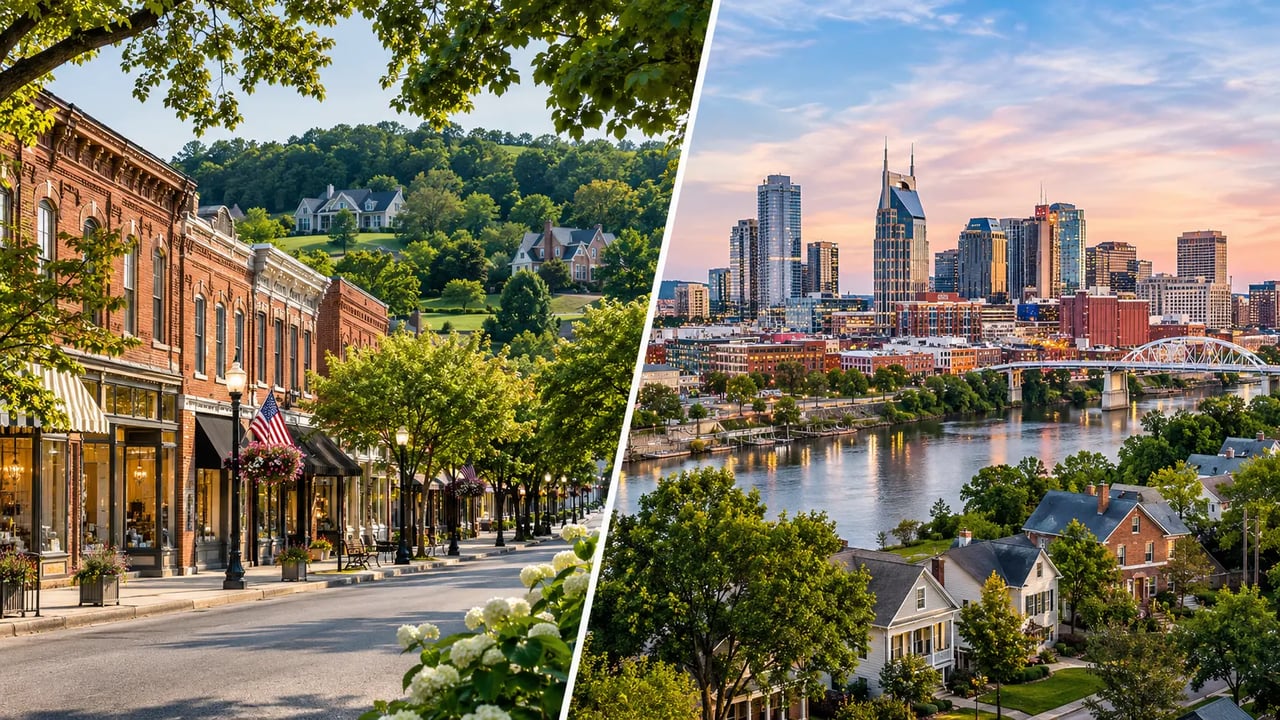
Williamson County is known for its suburban communities, upscale housing, historic downtowns, and highly regarded public schools. Davidson County, home to Nashville, offers a more urban environment, diverse neighborhoods, entertainment, and a wider variety of housing types.
So, which is better: Williamson County or Davidson County?
The answer depends on your priorities. Williamson County is often a better match for homebuyers seeking suburban living, larger properties, and specific school districts. Davidson County may be a stronger choice for people who value proximity to Nashville employers, urban amenities, and a broader range of housing options.
Let's explore the differences to help you decide where to call home in 2027.
1. Williamson County vs. Davidson County: An Overview
Although neighboring counties, Williamson and Davidson offer distinct living experiences.
Williamson County, Tennessee
Located immediately south of Nashville, Williamson County includes communities such as Franklin, Brentwood, Nolensville, Thompson's Station, Fairview, and parts of Spring Hill.
With its scenic countryside, historic landmarks, shopping centers, and established residential communities, Williamson County appeals to buyers seeking a suburban or small-town atmosphere with access to a major metropolitan area.
Franklin, the county seat, is particularly popular for its historic downtown, restaurants, local events, and residential neighborhoods.
Davidson County, Tennessee
Davidson County includes most of Nashville and many surrounding neighborhoods and communities, including Bellevue, Antioch, Donelson, Hermitage, Madison, and Old Hickory.
As the region's urban center, Nashville offers major employers, universities, healthcare facilities, entertainment venues, and a nationally recognized music scene.
While downtown Nashville is highly urbanized, Davidson County also contains suburban neighborhoods, established residential areas, parks, and quieter communities.
Williamson County vs. Davidson County at a Glance
Category | Williamson County | Davidson County |
|---|---|---|
Overall atmosphere | Suburban and small-town | Urban, suburban, and mixed |
Major city | Franklin | Nashville |
Population, 2025 estimate | 272,061 | 745,904 |
Housing | Higher-priced overall | Broader price range |
Public schools | Williamson County Schools and Franklin Special School District | Metro Nashville Public Schools |
Entertainment | Local festivals, restaurants, shopping | Concerts, nightlife, arts, professional sports |
Commuting | Longer for many Nashville-bound workers | Often shorter for centrally located jobs |
Property types | Detached houses, townhomes, acreage | Condos, townhomes, detached houses |
Ideal priorities | Space, suburban lifestyle, school zoning | City access, amenities, housing variety |
Key takeaway: Williamson County generally emphasizes suburban living, while Davidson County provides a greater range of urban and suburban experiences.
2. Real Estate and Housing: Where Will Your Money Go Further?
One of the biggest differences between Williamson County and Davidson County is housing affordability.
Williamson County Real Estate Market
Williamson County is one of Middle Tennessee's more expensive housing markets.
Its desirable residential areas, larger properties, established neighborhoods, and demand for homes within particular school zones contribute to relatively high purchase prices.
Buyers can find luxury estates, modern new-construction homes, traditional single-family properties, townhomes, and rural acreage.
Popular locations include Franklin and Brentwood, although buyers may find different price points in Fairview, Thompson's Station, and portions of Spring Hill.
In October 2026, Franklin's median home sale price was approximately $849,000, illustrating the higher cost of purchasing in one of Williamson County's best-known communities.
Prices vary significantly by neighborhood, square footage, property condition, and location.
Davidson County Real Estate Market
Davidson County offers a wider range of housing types and price points.
Buyers can choose from downtown condominiums, historic homes, urban townhouses, established suburban properties, and newer residential developments.
Neighborhoods such as Green Hills, East Nashville, and 12 South may command premium prices, while other areas offer comparatively lower entry points.
In October 2026, Nashville's median home sale price was approximately $457,000.
This difference highlights why buyers with limited budgets often find more options in Davidson County, although affordability varies considerably across Nashville neighborhoods.
Which County Is Better for Homebuyers?
Choose Williamson County if:
- You prefer a suburban or small-town setting.
- A larger home or lot is a priority.
- You're comfortable with a higher housing budget.
- You want to explore newer developments and established residential communities.
Choose Davidson County if:
- You prefer access to urban amenities.
- You want a wider selection of housing styles.
- You're considering condominiums or townhomes.
- You need flexibility across different price ranges.
Bottom line: Davidson County generally offers more housing variety and lower-cost entry points, while Williamson County appeals to buyers willing to spend more for particular communities and property characteristics.
3. Cost of Living: Is Williamson County More Expensive Than Davidson County?
Yes, Williamson County is generally more expensive than Davidson County, largely because of housing costs.
However, your actual expenses depend on where you live, whether you rent or own, and how frequently you commute.
Housing and Rental Expenses
Housing is usually the biggest factor affecting the cost-of-living difference.
According to U.S. Census Bureau estimates covering 2020–2024:
Housing expense | Williamson County | Davidson County |
|---|---|---|
Median owner-occupied home value | $751,900 | $417,400 |
Median monthly gross rent | $1,969 | $1,582 |
Median monthly owner costs with mortgage | $2,642 | $1,910 |
These are historical Census estimates, not current asking prices or mortgage quotes. They nevertheless illustrate the substantial difference in housing costs.
Property Taxes
Property taxes are another important consideration when comparing Williamson County vs. Davidson County.
For 2026, Williamson County's basic county-only rate is $1.30 per $100 of assessed property value. Combined rates vary by city and applicable special school district.
Metro Nashville's combined property tax rate is $2.814 per $100 of assessed value.
Tennessee generally assesses residential property at 25% of its appraised value for property tax purposes.
A lower tax rate does not necessarily mean a lower tax bill. For example, a higher-valued Williamson County home can generate a substantial tax bill even when its applicable rate is lower.
Before purchasing, compare actual annual property taxes for individual addresses instead of relying exclusively on countywide rates.
Transportation and Everyday Expenses
Transportation may also affect your budget.
A Williamson County resident commuting into downtown Nashville could spend more on fuel, vehicle maintenance, and time in traffic.
Davidson County residents living closer to their jobs may have shorter commutes, although traffic congestion, parking costs, and neighborhood location can change that equation.
Cost-of-living verdict: Davidson County typically provides a more accessible starting point for housing, while Williamson County may justify its higher costs for buyers prioritizing specific residential features and locations.
4. Schools and Education: Which County Has Better Options?
For households evaluating public education, school zoning is often a major factor in deciding where to live.
Both counties offer educational opportunities, but their school systems differ.
Williamson County Schools
Williamson County Schools serves much of Williamson County and is widely recognized for its academic reputation.
The district includes elementary, middle, and high schools across communities such as Brentwood, Franklin, and Nolensville.
Parts of Franklin are also served by the Franklin Special School District for elementary and middle grades.
Families considering Williamson County should research:
- Specific assigned schools
- Academic programs and student support
- Extracurricular activities
- School capacity and enrollment requirements
- Transportation and attendance zones
School boundaries can change as communities grow, so checking a property's current zoning is essential.
Metro Nashville Public Schools
Davidson County is primarily served by Metro Nashville Public Schools (MNPS).
The district provides neighborhood schools along with specialized programs and school-choice opportunities, subject to eligibility and enrollment rules.
Families may explore academic pathways, arts programs, career-focused education, and other learning options.
Because Davidson County is geographically and economically diverse, school experiences and available programs vary by campus.
Which County Is Better for Schools?
Williamson County is a popular choice among buyers who prioritize particular public school zones.
However, Davidson County offers numerous educational options, and an individual school's suitability depends on the student's needs.
The smartest approach is to compare individual schools rather than assuming every school within one county is superior to every school in the other.
5. Lifestyle and Entertainment: Suburban Comfort vs. Nashville Energy
Your preferred lifestyle may ultimately determine which county is right for you.
Life in Williamson County
Williamson County offers a blend of suburban convenience, historic character, and outdoor recreation.
Residents can enjoy walking through downtown Franklin, visiting independent boutiques, dining at local restaurants, or spending time in community parks.
Popular attractions and experiences include:
- Historic Downtown Franklin
- The Factory at Franklin
- Arrington Vineyards
- Local farmers markets and community festivals
- Parks, walking trails, and scenic countryside
Williamson County is especially appealing to people who enjoy a slower-paced environment while remaining connected to Nashville.
However, some communities are car-dependent, and certain entertainment options may require driving into Nashville.
Life in Davidson County
Davidson County offers a lively mix of music, food, entertainment, arts, sports, and outdoor recreation.
Nashville is internationally recognized for its music industry, but its appeal extends beyond country music.
Residents can enjoy live performances, restaurants, neighborhood coffee shops, professional sporting events, and cultural attractions.
Popular destinations include:
- Downtown Nashville and Broadway
- The Gulch
- Centennial Park
- The Country Music Hall of Fame and Museum
- The Frist Art Museum
- Percy and Edwin Warner Parks
- Neighborhood entertainment districts throughout Nashville
Davidson County can be an excellent choice for people who value spontaneous outings, cultural experiences, and proximity to city amenities.
Lifestyle Verdict
Williamson County may be more attractive if you prefer residential space, suburban neighborhoods, and community-centered activities.
Davidson County may suit you better if you enjoy diverse dining, entertainment, nightlife, and access to city attractions.
Neither county offers only one type of lifestyle. Franklin has lively shopping and restaurant districts, while Nashville contains many quiet suburban neighborhoods.
6. Jobs and Commuting: Which County Is More Convenient?
Employment and commuting are important considerations for anyone relocating to Middle Tennessee.
Working in Williamson County
Williamson County has an established business community, including healthcare, corporate services, technology, retail, and professional services.
Franklin and Brentwood contain major office developments and employment centers.
For residents who both live and work in Williamson County, commuting can be relatively convenient depending on their exact locations.
However, residents traveling north into Nashville may encounter congestion along Interstate 65 and other major routes.
Working in Davidson County
Davidson County is the region's largest employment center.
Nashville offers opportunities across healthcare, hospitality, music, education, finance, technology, logistics, and government.
Major employment districts are located downtown, in Midtown, around medical centers, and throughout surrounding business areas.
Living in Davidson County can reduce commuting distances for certain Nashville-based jobs.
However, shorter distances do not always guarantee faster trips, particularly during rush hour.
What About Remote Workers?
Remote and hybrid workers may have more flexibility.
If commuting is infrequent, Williamson County's residential space or Davidson County's neighborhood amenities may matter more than daily access to an office.
Commuting tip: Before buying a home, test the drive between the property and your workplace during your normal commuting hours.
7. Best Places to Live in Williamson County and Davidson County
Both counties contain several distinct communities worth considering.
Popular Williamson County Communities
Franklin, TN
Franklin combines historic charm with modern shopping, restaurants, parks, and residential developments.
It's appealing to buyers seeking a suburban community with a lively downtown.
Brentwood, TN
Brentwood is known for upscale residential areas, spacious properties, and access to employment centers along the Nashville–Franklin corridor.
Buyers should confirm the county and school district for any specific property, since the Brentwood area includes locations near the county boundary.
Nolensville, TN
Nolensville offers a small-town atmosphere, newer residential developments, and access to southeastern Williamson County.
Thompson's Station, TN
Thompson's Station appeals to buyers interested in growing residential communities, open spaces, and a setting south of Franklin.
Fairview, TN
Fairview offers a more rural and small-town environment within Williamson County and may provide alternatives to some of the county's higher-priced locations.
Popular Davidson County Communities and Neighborhoods
East Nashville
Known for its independent restaurants, creative atmosphere, historic housing, and neighborhood character.
Green Hills
A popular residential and shopping area with established homes, retail destinations, and relatively convenient access to central Nashville.
Bellevue
Offers a suburban atmosphere, shopping, residential communities, and access to Warner Parks.
Donelson
Provides a mix of established neighborhoods, local businesses, and access to Nashville International Airport.
Hermitage
Features suburban housing choices, recreation opportunities, and access to eastern Davidson County employment centers.
The Nations
A changing Nashville neighborhood known for redevelopment, restaurants, townhomes, and proximity to central Nashville.
The right neighborhood depends on your budget, housing preferences, commute, and desired amenities.
8. Pros and Cons of Living in Williamson County vs. Davidson County
Williamson County: Pros and Cons
Advantages
- Popular suburban communities
- Highly regarded public school district
- Historic downtowns and local events
- Options for larger lots and detached houses
- Attractive parks and outdoor spaces
- Convenient access to southern Nashville employment corridors
Potential disadvantages
- Higher overall home prices
- Fewer lower-cost housing options in many neighborhoods
- Longer commutes to downtown Nashville
- Car-dependent communities
- Increasing traffic in growing suburban areas
Davidson County: Pros and Cons
Advantages
- Greater variety of housing styles and price points
- Access to major Nashville employers
- Extensive dining, arts, sports, and entertainment
- Both urban and suburban neighborhoods
- More opportunities to live near workplaces and attractions
- Multiple public and private education options
Potential disadvantages
- Traffic congestion in major corridors
- Higher density in certain neighborhoods
- Parking challenges in some urban areas
- Property tax rates that may be higher than those in some Williamson County jurisdictions
- Significant neighborhood-to-neighborhood differences in housing costs and amenities
9. Williamson County vs. Davidson County: Which Should You Choose?
Ultimately, the best county depends on what matters most to you.
Choose Williamson County If You Prioritize:
- A suburban or small-town residential setting
- Larger properties and detached houses
- Access to specific public school zones
- Historic charm and community activities
- Being close to Franklin, Brentwood, or southern Nashville employers
Choose Davidson County If You Prioritize:
- Proximity to Nashville's major employment districts
- Restaurants, concerts, cultural venues, and nightlife
- Greater housing variety
- More urban or mixed-use neighborhoods
- A wider choice of price points
What About First-Time Homebuyers?
First-time buyers may find Davidson County more approachable because of its broader housing selection.
However, some parts of Davidson County are highly expensive, and buyers should compare individual neighborhoods and property types before making assumptions.
What About Households With Children?
Williamson County is frequently considered by households interested in its public school system and suburban environment.
Davidson County also offers family-oriented neighborhoods, parks, educational programs, and community amenities.
The right choice depends on school fit, housing affordability, transportation, and household preferences.
What About Retirees?
Retirees seeking a smaller-town atmosphere may prefer communities such as Franklin, Fairview, or Thompson's Station.
Those who prioritize proximity to healthcare facilities, entertainment, and a wider variety of housing types may prefer certain Davidson County neighborhoods.
10. Frequently Asked Questions About Williamson County vs. Davidson County
Is Williamson County better than Davidson County?
Williamson County may be better for buyers seeking suburban living, larger residential properties, or access to particular school districts. Davidson County may be better for those who prioritize urban amenities, proximity to Nashville jobs, and housing variety. Neither is universally better.
Is Williamson County more expensive than Davidson County?
Yes, Williamson County generally has higher housing costs. Historical Census housing data and recent Franklin and Nashville market figures indicate a substantial price difference, although individual neighborhoods vary.
Which county has lower property taxes?
Many Williamson County jurisdictions have lower nominal property tax rates than Metro Nashville. However, total tax bills depend on property values, municipality, school district, and other applicable factors.
Is Franklin, Tennessee, in Williamson County?
Yes. Franklin is the county seat of Williamson County and one of the most prominent communities south of Nashville.
Is Nashville in Davidson County?
Yes. Nashville is primarily located in Davidson County and serves as Tennessee's capital.
How far is Williamson County from Nashville?
Williamson County borders Davidson County directly to the south. Travel distances vary based on the community and destination. Franklin is approximately 20 miles south of downtown Nashville by road, depending on the route.
Which county is better for commuting to Nashville?
Davidson County is often more convenient for commuting to central Nashville workplaces, but commute times depend on your specific home, workplace, departure time, and road conditions.
Does Williamson County have good schools?
Williamson County Schools has a strong academic reputation. Buyers should still research individual campuses, educational offerings, and confirmed attendance zones.
Can you find affordable homes in Williamson County?
Relatively lower-priced opportunities may be available in communities such as Fairview, parts of Spring Hill, and other locations outside the most expensive neighborhoods. Affordability depends on the current inventory, property size, and buyer budget.
Should I buy a house in Franklin or Nashville?
Choose Franklin if you value its suburban setting, historic downtown, and residential character. Consider Nashville if you want a broader variety of neighborhoods, access to city employment, and more entertainment options.
11. Final Thoughts: Finding Your Place in Middle Tennessee
Choosing between Williamson County vs. Davidson County isn't simply about comparing home prices or school districts. It's about finding a place that supports the lifestyle you want to build.
Williamson County offers beautiful suburban communities, historic charm, established neighborhoods, and access to the growing Middle Tennessee economy.
Davidson County offers Nashville's cultural energy, extensive employment opportunities, diverse housing options, and neighborhoods ranging from urban to suburban.
Both counties have much to offer.
Before making a decision, visit several neighborhoods, explore available homes, confirm school zones, compare property taxes, and experience the commute firsthand.
The best place to live isn't necessarily the county with the highest home values or the most entertainment. It's the community that fits your budget, daily routine, and long-term goals.
Whether you're drawn to Franklin's historic Main Street or Nashville's vibrant neighborhoods, Middle Tennessee offers opportunities to find a place that feels like home.
Planning a move to Middle Tennessee? Start by comparing neighborhoods, touring homes, and identifying the features that matter most to you. The right location could make all the difference in your next chapter.